Published: November 23, 2026 | By the SurferFood Editorial Team
The packing list gets you to the beach. The burner is what you eat from. Surfd's van guide keeps the kitchen to one burner, one pot, and one pan: oats or granola in the morning, a stir-fry at night, and a canned tuna sandwich when you are too tired to cook [1].
Key takeaways
- Cook on one burner, in one pot or one pan. A full kitchen stays home [1].
- Stock rice, oats, canned tuna, peanut butter, dried fruit, and nuts. Keep eggs, and anything you have opened, on ice [3][4].
- Morning is the egg and rice pre-surf bowl. The no-cook meal is the tuna and white bean jars. The fish tacos wait for a pan that is not frying fish inside a closed van.
- Keep perishable food out of the band from 40 F to 140 F. Refrigerate it within 2 hours, or within 1 hour if the air is above 90 F. Reheat leftovers to 165 F [3].
- If the cooler ice is gone, throw the perishable food out and eat the shelf-stable food [4]. The trip list itself is the surf trip packing guide.
What belongs in a one-burner surf kitchen?
Surfd's kit is one burner, one pot, and one pan. That covers oats, a stir-fry, and a tuna sandwich. A full kitchen is on their skip list. You will eat from the pot more often than you plate a course [1]. Outside's van cookbook report ranks recipes by the burners a meal needs, so you do not start a multiburner recipe on a single-burner stove [2]. Pack plastic containers and a vegetable peeler, plus a food thermometer. USDA says color is not a reliable sign that meat or poultry is done [4]. This page does not name a stove brand or a price.
Shelf-stable food covers the day the ice fails. USDA's camping list includes peanut butter, canned tuna, ham, chicken, and beef, dried noodles and soups, rice, dried fruit, nuts, and powdered milk. Whole fresh fruit can ride outside the cooler. Once you open a can, put the rest on ice [4].
The surf trip packing guide is still the cooler list and the day-by-day rhythm. Use that page for what to bring. Use this page for the pot.
One flame
Three plates from one burner
Follow the recipe page for the method. If you change the ingredients, do not borrow the macro line printed there.
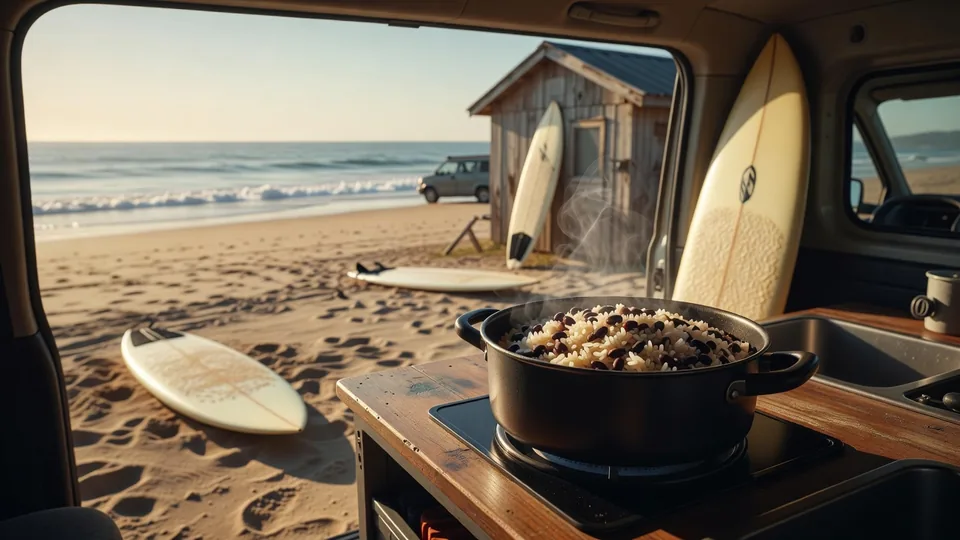
- Morning: the egg and rice pre-surf bowl. Heat leftover rice until it is hot through, then cook the eggs in that same pan. Eat it early enough that you are not paddling on a full stomach.
- After the last session, the fish tacos are one skillet. Do not fry that fish inside a closed van. Outside's piece says the smell of fried fish in a small van stays [2].
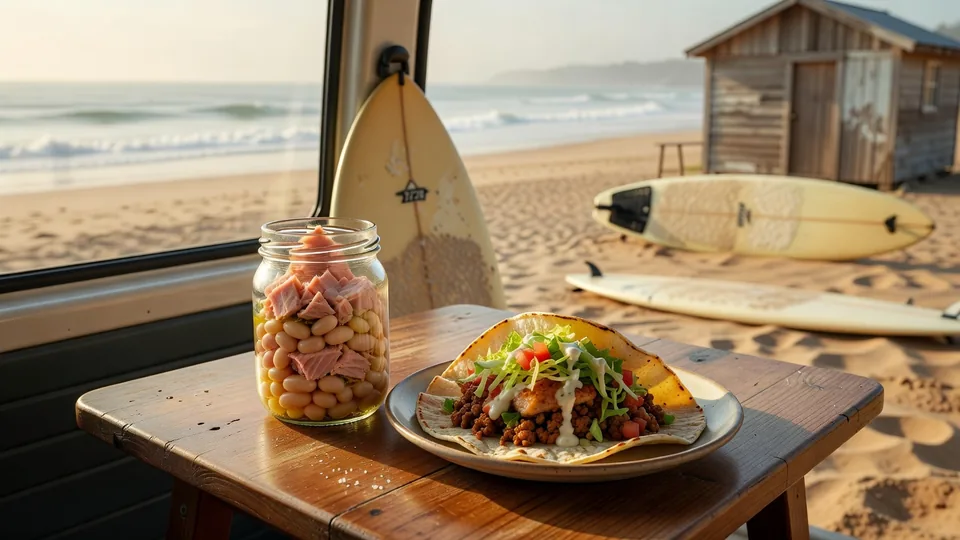
- No cook: the tuna and white bean jars. This is lunch when you will not light the burner. Surfd's canned tuna sandwich is the same idea with bread [1].
- Backup handful from the USDA camping list: peanut butter, nuts, or dried fruit, plus whole fruit that does not need ice [4].
Cook rice the night before and cool it fast. One pot at dinner is enough.
How do you keep food safe in a van?
If the van has a refrigerator, refrigerate perishable food within 2 hours, or within 1 hour above 90 F. Leftovers keep 3 to 4 days in the fridge and 3 to 4 months in the freezer. They stay safe longer when frozen, but they can dry out. Reheat to 165 F. Bring sauces, soups, and gravies to a rolling boil. Divide a full pot into shallow containers so it cools. Hot food can go straight into the refrigerator [3].
In a cooler, a block of ice keeps food colder for longer than cubes. Frozen gel packs work too. Pack raw meat below ready-to-eat food and bag it so juices do not drip. Keep the cooler in the shade. Put drinks in a separate cooler if you have one, because opening the drink cooler melts the ice faster. Perishable leftovers are safe only while ice remains. If the ice is gone, throw that food out [4].
Bacteria grow quickly between 40 F and 140 F. Hot food needs to stay at 140 F or warmer. Cold perishable food needs to stay at 40 F or below [3]. Wash hands with soap and warm water for at least 20 seconds after raw food [5]. With no running water, bring hand sanitizer that is at least 60 percent alcohol. Pack drinking water. A clear stream is not a safe source [4].
Use a thermometer. Steaks, chops, and roasts of beef, pork, lamb, and veal need 145 F and a rest of at least 3 minutes. Ground beef, pork, lamb, and veal need 160 F. Poultry needs 165 F. Most seafood needs 145 F, or flesh that is clear and separates with a fork. Clean the thermometer between foods [3][4][5].
On a two-session day, cool tonight's rice in a shallow container inside the 2 hour window [3]. Morning is the egg and rice bowl. Between sessions, eat the tuna jars or the shelf-stable handful. After the last surf, one pot is enough [1].
This article is educational and is not medical advice. It is not a treatment plan. If you have a medical condition or take medicines that change fluid, salt, or food needs, talk with a qualified clinician.
FAQ
What can I cook with one burner?
Oats or rice, eggs, and a one-pan meal. Use the egg and rice bowl in the morning and the tuna jars when you will not light the stove.
Can I fry fish inside the van?
Do not fry fish inside a closed van. Outside's van cooking piece says the smell of fried fish in a small van is a mistake you only make once. Eat the tuna and white bean jars on those nights.
How long can leftovers sit out?
Refrigerate perishable leftovers within 2 hours, or within 1 hour above 90 F. In a refrigerator they keep 3 to 4 days. Reheat them to 165 F. In a cooler they are safe only while ice remains.
What if the ice melts?
Throw out perishable food once the ice is gone or the gel pack is no longer frozen. Eat unopened canned tuna, peanut butter, dried fruit, and nuts instead.
Do I need a special stove brand?
No. This page does not rank stoves or list prices. Bring the burner you already use, one pot, one pan, and a food thermometer.
Start with the egg and rice pre-surf bowl, keep the tuna and white bean jars for the cold lunch, and use the surf trip packing guide for the cooler. Save the fish tacos for a pan that is not inside a closed van.
Sources
- [1] Surfd, "The Van Life Surf Guide: What You Really Need (and What You Really Do Not)," 21 July 2025. https://surfd.com/2025/07/the-van-life-surf-guide-what-you-really-need-and-what-you-really-dont
- [2] Outside, "How to Cook Gourmet Meals in Your Van," April 20, 2018. https://www.outsideonline.com/food/cooking-gourmet-meals-your-van/
- [3] U.S. Department of Agriculture, Food Safety and Inspection Service, "Leftovers and Food Safety," updated July 31, 2020. https://www.fsis.usda.gov/food-safety/safe-food-handling-and-preparation/food-safety-basics/leftovers-and-food-safety
- [4] U.S. Department of Agriculture, Food Safety and Inspection Service, "Food Safety While Hiking, Camping and Boating." https://www.fsis.usda.gov/food-safety/safe-food-handling-and-preparation/food-safety-basics/food-safety-while-hiking-camping
- [5] U.S. Food and Drug Administration, "Selecting and Serving Fresh and Frozen Seafood Safely." https://www.fda.gov/food/buy-store-serve-safe-food/selecting-and-serving-fresh-and-frozen-seafood-safely
Next Step
Open the Egg and Rice Bowl
Heat leftover rice, cook the eggs in the same pan, and follow the recipe page for the method. Do not borrow its macro line if you change the ingredients.