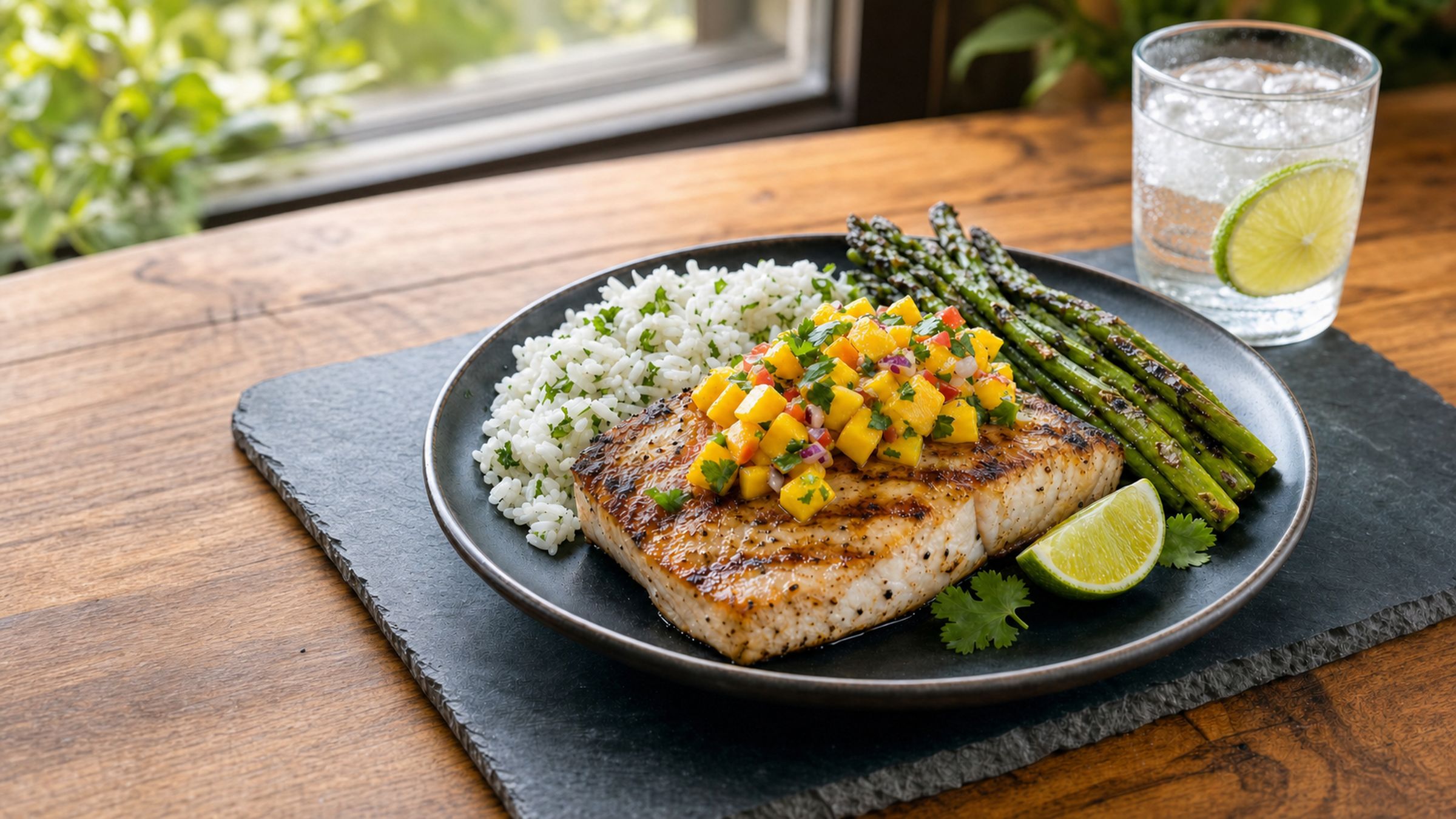
Published: September 14, 2026 | By the SurferFood Editorial Team
Skip high-risk reef fish when you travel through warm water, especially barracuda and moray eel. Ciguatera is not "bad sushi handling." It is a toxin that builds up the food chain on coral reefs. CDC Travelers' Health says you get it by eating fish contaminated with toxins from algae around reefs, that the fish can look, smell, and taste normal, and that "Cooking does not destroy the toxins" [1]. CDC Yellow Book notes that symptoms usually start 3 to 6 hours after the meal, can wait as long as 30 hours, and that incidence in travelers to highly endemic areas has been estimated as high as 3 per 100 [2]. This page is food-safety education for surf trips. It is not a diagnosis tool.
Key takeaways
- CDC says ciguatera toxins do not change how the fish looks, smells, or tastes, and cooking does not destroy them [1].
- Yellow Book lists typical onset at 3 to 6 hours, sometimes up to 30 hours, and an estimated traveler incidence as high as 3 per 100 in highly endemic areas [2].
- Highest-risk fish include barracuda and moray eel. Also treat large reef predators with caution: grouper, amberjack, snapper, sea bass [1][2].
- Do not eat the head, liver, intestines, or roe of reef fish. Those parts concentrate toxin [1][2].
- If you get sick after reef fish, seek medical care. There is no simple home cure [1].
Why Surfers Care
Why is this a surf-travel issue?
The same latitudes that hold good reefs hold ciguatera risk: tropical and subtropical waters, often listed between about 35 degrees north and 35 degrees south, especially the Pacific, Indian Ocean, and Caribbean [2]. Surf trips run on grilled fish and "the catch of the day." That is the exposure. You do not get ciguatera from the ocean on your skin. You get it from a plate.
What is ciguatera, in plain language?
Tiny reef algae make toxins. Small fish eat the algae. Bigger fish eat those fish. The toxin concentrates as it moves up. You eat the bigger fish. CDC names Gambierdiscus in the clinician Yellow Book write-up and explains that ciguatoxins collect in liver, intestines, roe, and heads [2]. The fish is not spoiled in the usual kitchen sense. Standard smell and look tests fail.
That is why local confidence can still be wrong. Canada.ca notes that outbreaks are patchy: one fish on one day may be fine and the same species the next day may not [3]. A crowded surf camp grill is not a laboratory.
Which fish should surf travelers treat as high risk?
CDC Travelers' Health lists barracuda, moray eel, grouper, amberjack, sea bass, sturgeon, parrotfish, surgeonfish, and red snapper among fish you may want to avoid [1]. Yellow Book is blunt on the top tier: never eat high-risk fish such as barracuda and moray eel, and be careful with reef fish that weigh more than about 5 pounds [2]. Canada.ca uses a similar list and flags fish over about 3 kg [3].
Pelagic fish that do not live on the reef, such as many tuna and some mahi-mahi, are a different risk conversation. They are not a free pass. They are usually outside the classic ciguatera chain. If you want a home plate in that lane, our grilled mahi-mahi recovery plate is a grocery-store recipe, not travel advice for a night market.
What symptoms should send you to care?
CDC says symptoms usually start 3 to 6 hours after the meal and can wait up to 30 hours. Common early signs are nausea, vomiting, diarrhea, and stomach pain. Less common signs include tingling, tooth pain or loose-tooth feeling, itching, metallic taste, blurred vision, and odd hot-cold sensation [1]. Yellow Book calls cold allodynia, pain from cold, a classic clue when it shows up [2].
Symptoms can last days and sometimes linger for months [1][2]. There is no cure that erases the toxin. Care is supportive. CDC notes that after recovery, some people are told to avoid fish, nuts, alcohol, and caffeine for a period because symptoms can flare [1]. That is a clinician conversation, not a self-protocol from a blog.
How do you eat on a surf trip without guessing?
Ask what the fish is, where it was caught, and skip the "mystery grill" when you are in a known reef area. Prefer smaller fish from controlled markets when you eat reef species at all [3]. Pack backup protein so you are not stuck choosing barracuda at 10 p.m. Our surf-trip packing guide and tuna and white bean jars exist for that gap.
Cooking, freezing, smoking, and lemon juice do not fix ciguatera [1][2][3]. A well-done fillet can still be a problem fillet. If someone at the camp gets sick after the same fish, take that seriously and get care. This is not the time to "surf it out."
This article is educational and is not medical advice. It is not a treatment plan. If you have a medical condition or take medicines that change fluid, salt, or food needs, talk with a qualified clinician.
Frequently asked questions
What is ciguatera and how do surfers get it?
Ciguatera is poisoning from reef-fish toxins that start in algae and concentrate up the food chain. You get it by eating contaminated fish, not by surfing in the water. The fish can taste normal. Cooking does not destroy the toxin, according to CDC.
Which fish should I avoid on a tropical surf trip?
CDC highlights barracuda and moray eel as high risk, and lists other reef species such as grouper, amberjack, snapper, and sea bass. Skip the head, liver, intestines, and roe. When in doubt, pick a different protein you can name.
Can I cook ciguatera out of the fish?
No. CDC states that cooking does not destroy the toxins. Freezing, smoking, drying, and canning do not either. If the fish already carried the toxin, the cooked fillet still carries it. Choose a different protein instead of hoping heat will help.
How soon do ciguatera symptoms start?
CDC says symptoms usually start 3 to 6 hours after the meal and may begin up to 30 hours later. Early signs are often stomach illness, then tingling or odd temperature feelings. Seek medical care if this happens after reef fish.
How common is ciguatera in travelers?
It varies by place. CDC Yellow Book reports that incidence in travelers to highly endemic areas has been estimated as high as 3 per 100. That is a published estimate, not your personal odds. Risk is patchy even inside one island.
What should I eat instead of reef fish on a surf trip?
Use packed meals, eggs, beans, dairy if you tolerate it, or fish with a known lower-risk source. The packing guide is built for exactly this problem. A cooler plan beats a late-night mystery grill on a reef island.
Sources
- [1] CDC Travelers' Health, Food Poisoning from Seafood (ciguatera and scombroid) - https://wwwnc.cdc.gov/travel/page/fish-poisoning-ciguatera-scombroid
- [2] CDC Yellow Book, Food Poisoning from Marine Toxins - https://www.cdc.gov/yellow-book/hcp/environmental-hazards-risks/food-poisoning-from-marine-toxins.html
- [3] Canada.ca, Ciguatera - https://www.canada.ca/en/public-health/services/diseases/ciguatera.html
Next Step
Pack Food You Can Trust
When local reef fish is a question mark, a cooler plan and cooked staples keep the trip fueled. Start with the packing guide.